
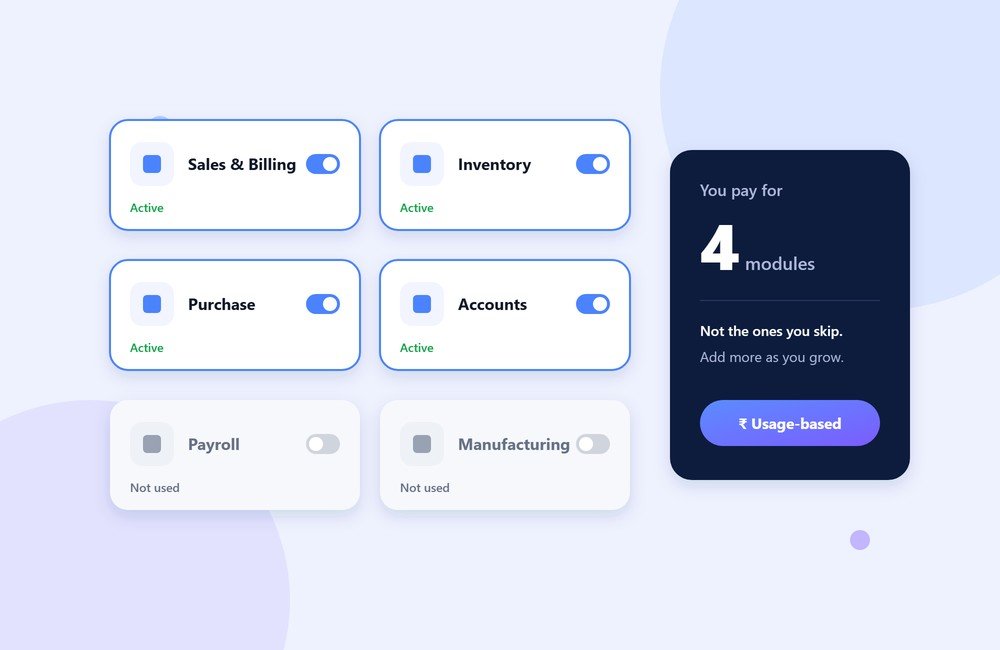
Business software is often priced as a single package. You get every feature, and you pay for every feature, whether your team uses them or not. For a large enterprise, that can be fine. For a growing B2B business, it often means paying for a manufacturing module when you do not manufacture, or a payroll module when payroll is handled by your accountant.
How modular pricing works
With modular pricing, the system is split into parts such as sales and billing, inventory, purchase, accounts and payroll. You switch on the modules your business needs and pay for those. When your needs change, you add a module. The data and the system stay the same; only the set of active features changes.
Why it suits growing businesses
- Lower starting cost. You begin with the essentials instead of the full suite.
- No migration when you grow. Adding inventory or payroll later does not mean moving to a new platform and re-entering your data.
- Simpler for staff. People only see the parts of the system they use, which shortens the learning curve.
- Cost follows value. What you pay reflects what the software is actually doing for you.
Questions to ask any vendor
Modular pricing is only useful if it is transparent. Whatever system you are considering, ask:
- Exactly what is included in each module, and what costs extra?
- Can modules be added or removed later, and how quickly?
- Do modules share the same data, or are they separate products bundled together?
- Are there per-user charges on top of per-module charges?
- What happens to your data if you switch a module off?
Our approach with Sares ERP
Pay-for-what-you-use pricing is a core part of Sares ERP, our ERP for B2B businesses. A smaller business should not pay for capability it will not touch, and a larger one should be able to grow into the rest without changing platforms. Sares ERP is in final development and not yet available to buy. If you would like to be told when it launches, get in touch.